Copenhagen’s skyline is a blend of historic spires and modern, sustainable architecture, but few recent additions are as instantly recognizable — or as debated — as the two towers near Dybbølsbro: the Cactus Towers (Kaktustårnene). These spiky structures, whose facades bristle with angular balconies, represent more than just modern aesthetics; they are a striking answer to the city’s urgent need for affordable, high-density housing.
The Vision of BIG and the Prickly Design
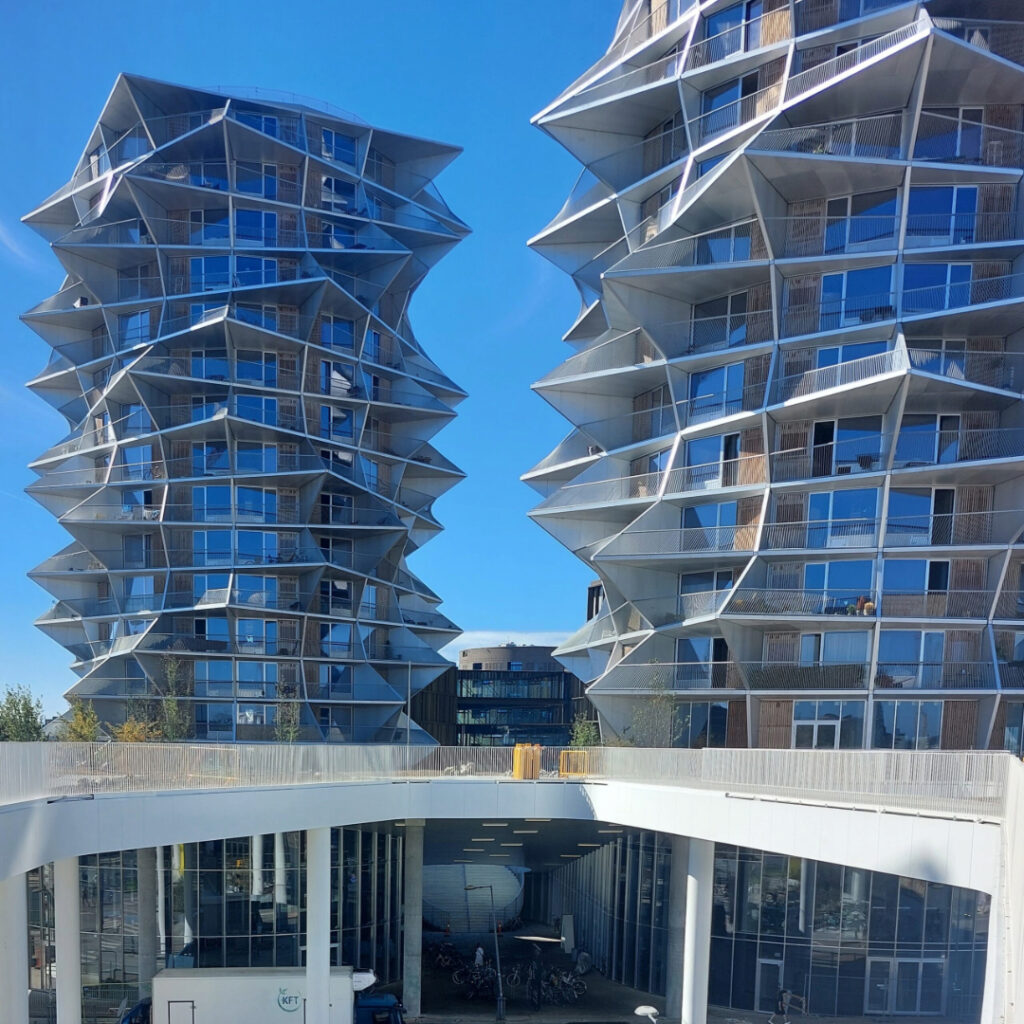
The genesis of the Kaktus Towers lies with the renowned Danish architectural firm, BIG (Bjarke Ingels Group). In 2017, BIG unveiled the ambitious design as part of a larger urban redevelopment effort in the Kalvebod Brygge area. The towers earn their botanical name from their unmistakable exterior. Rather than a typical rectilinear high-rise, the design is structured around a central, hexagonal core. Each floor plate is slightly rotated, or “twisted,” and cantilevered out, creating a cascade of sharp, angular balconies that spiral up the building. This architectural choice gives the structure its unforgettable, prickly silhouette, a clear visual reference to a cactus. The final construction resulted in two twin towers, one rising to approximately 80 meters and the other to 60 meters, collectively providing a significant number of new homes on a compact footprint.
An Innovative Answer to Urban Living
Beyond the dramatic exterior, the Kaktus Towers were engineered to solve a critical contemporary urban challenge: how to house nearly 500 young people and single residents affordably in the expensive city center. The project embraces a micro-apartment or “co-living” model, where individual units are kept small—typically ranging from 33 to 53 square meters—to maximize density and keep rental costs manageable.
This approach is summarized by the philosophy: “Sleep in the apartment – live in the building.” The design compensates for the small private spaces by prioritizing massive shared facilities. Residents gain access to expansive communal lounges, shared kitchens, party rooms, and indoor and outdoor fitness areas that encourage social interaction and foster a strong sense of community. The two towers are even physically linked at their base by an elevated, sloped public park and commercial plaza, creating a functional, green hub for both residents and the surrounding neighborhood.
Completion and a Mixed Legacy
The Kaktus Towers began construction around 2019 and were structurally completed, welcoming their first residents, around mid-2022. The remaining communal facilities and the public park were finalized over the next couple of years. Like many of BIG’s provocative buildings, the Kaktus Towers sparked public debate, with some critics questioning the angular aesthetics and the small living spaces. However, the project has also earned significant international recognition. It has received prestigious accolades, including being named a winner in the category of Europe’s Best Tall Building by the Council on Tall Buildings and Urban Habitat, celebrating its innovative blend of economical construction and striking design. The towers stand today as a bold, contemporary statement, demonstrating a clever architectural solution to urban density.
Hasse “Hassan” Sørensen